
8 November 2026
Citation Checker: How to Make Sure Every Source in Your Paper Is Real
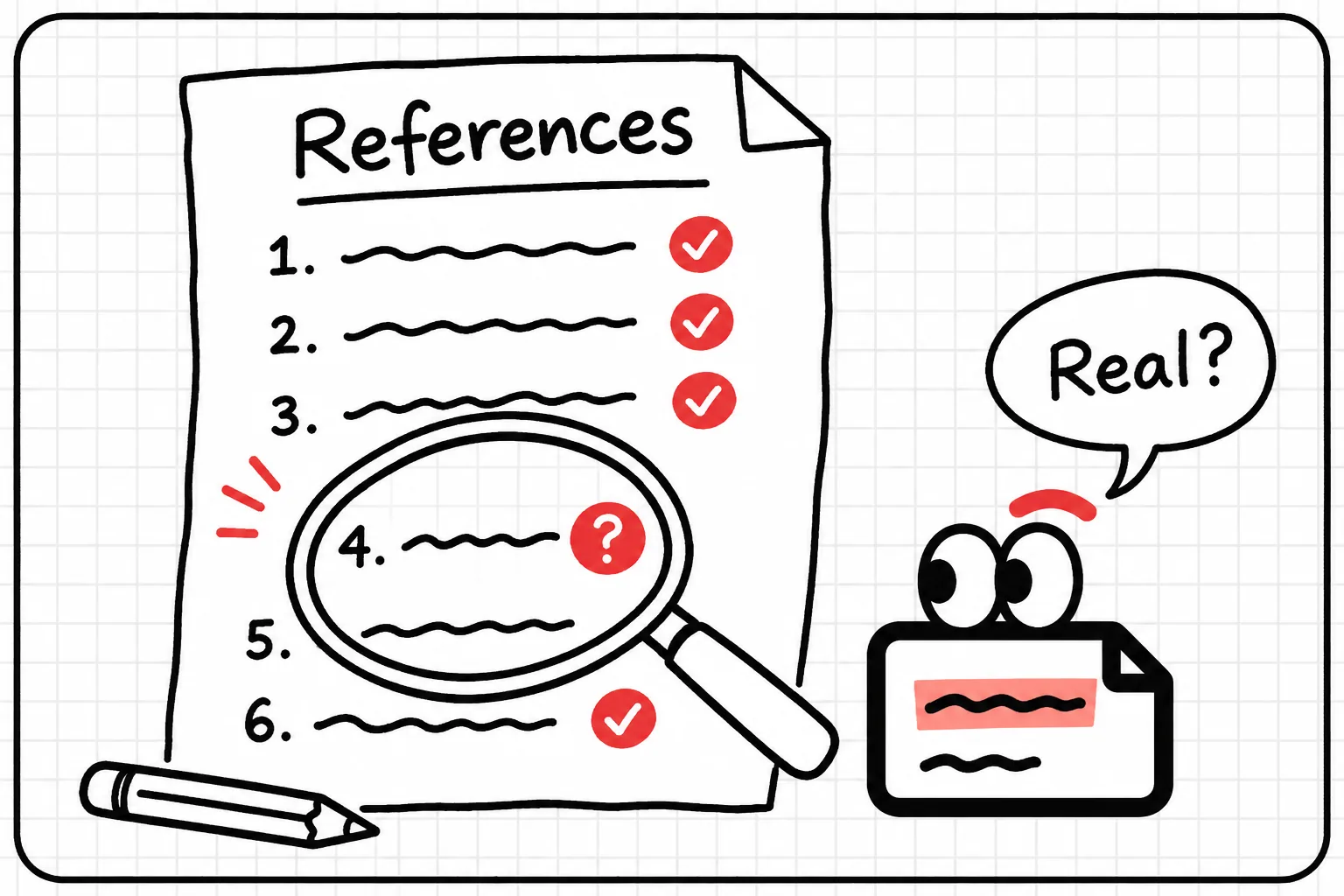
A missing comma in a reference costs you a point at most. A source that doesn't exist can cost you the whole paper, and a conversation with your professor about academic integrity.
That second problem used to be rare. It isn't anymore. If you used ChatGPT or any other AI tool at any point while researching, some of your references may point to articles nobody ever wrote. This guide shows you how to check every citation before you submit, in the order that protects your grade.
Why fake citations end up in real papers
AI chatbots don't look sources up. They predict text that looks like a reference: a plausible author, a plausible journal, a plausible year. Often the result is real. Sometimes it's a perfect-looking citation for an article that was never published.
This isn't a rare glitch:
- When researchers checked 636 references from ChatGPT-written literature reviews, 55% of the GPT-3.5 references and 18% of the GPT-4 references were fabricated (Walters & Wilder, Scientific Reports, 2023). Many of the real ones still had errors.
- In 2023, two New York lawyers were fined after filing a brief that cited court cases ChatGPT had made up (Mata v. Avianca, S.D.N.Y.).
Your professor only has to look up one of your references to find a fake one. That makes a fabricated source one of the riskiest things you can submit.
What a citation checker actually checks
"Citation checker" can mean three different things, and most tools only do one:
- Format. Is the reference written correctly in APA, MLA or Chicago? Generators and formatters handle this.
- Existence. Does the source exist at all? This needs a lookup in real databases, not a style rule.
- Support. Does the source say what your sentence claims it says? This is the one examiners care about most, and the one almost nobody checks.
A reference can pass the first test and fail the other two. So check them in reverse order of how often students check them: support and existence first, format last.
How to check your citations by hand
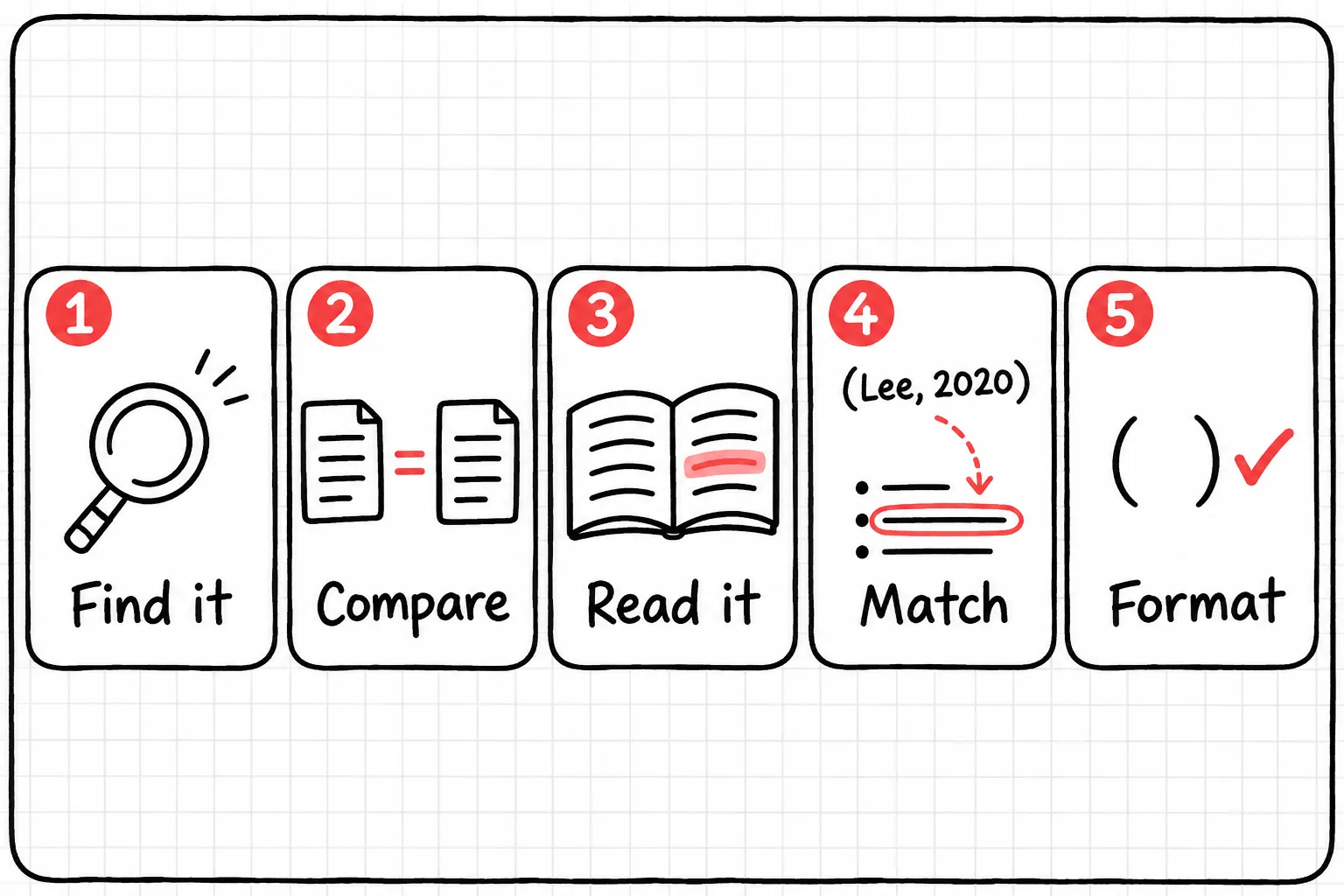
Set aside one focused session. For each reference:
1. Find the source itself. Search the exact title in quotes on Google Scholar or your library's search. If it has a DOI, paste it after https://doi.org/ and see whether it opens. A real journal article almost always turns up in one of these within a minute.
2. Compare the details. Check the author names, year, journal, volume and pages against what you see. A real article with the wrong year or a misspelled author is an easy fix. Two or more details that don't match anything is a warning sign.
3. Read the passage you cited. Open the source and find the part that supports your sentence. If you can't find it, your citation is either pointing to the wrong source or making a claim the source doesn't make.
4. Match in-text citations to the list. Every in-text citation needs an entry in your reference list, and every entry needs at least one citation in your text. Search your document for each author's name to confirm.
5. Only then, fix the format. Once you know every source is real and relevant, run through your style's rules.
What to do when a source won't turn up
Don't panic, and don't just delete it. Work down this list:
- Search with fewer words. Try the author's last name plus two distinctive words from the title.
- Check the author's other work. Real authors have a profile on Google Scholar, ORCID or a university page. If the author exists but never wrote anything like your title, the reference was probably invented.
- Find a real replacement. If the claim is true, a real source will support it. Search for the claim, not the fake title, and cite what you find.
- Rewrite the sentence. If you can't find any source for a claim, soften it or cut it. A weaker sentence is far better than a fabricated citation.
Never keep a reference you couldn't find "just in case". If you can't open it, neither can your professor.
A faster way to do it
Checking 30 references by hand takes an afternoon. That's why it so often happens at 2am, when you're least likely to notice a wrong year.
PickyProf reads your whole paper the way a picky professor would. It looks up every reference to see whether the source exists, flags the ones it can't find, and checks that your in-text citations and reference list match. The same check also reviews your citation style, your argument and your structure, and runs a plagiarism check.
Want every source checked before you hit submit? Upload your paper to PickyProf and get each questionable reference flagged, with feedback on the rest of your paper alongside it.
