12 November 2026
Is Your Thesis Statement Strong? A Thesis Statement Checker
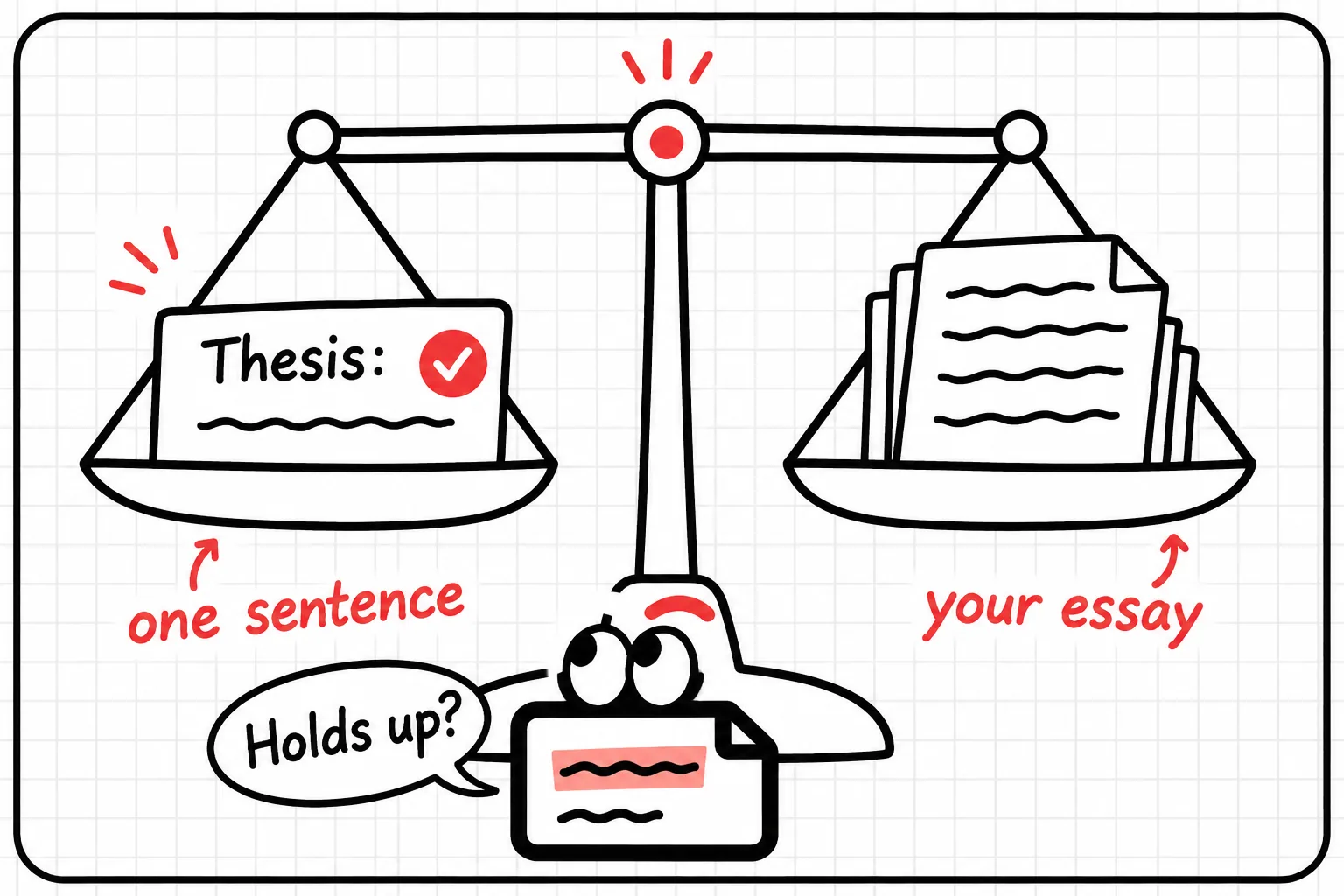
Your thesis statement is the one sentence your professor reads looking for your whole essay. If it's vague, everything after it reads as vague too. If it's sharp, even an average paragraph feels like it's going somewhere.
The good news is that a thesis is easy to test. Run yours through the five checks below. Each one comes with a weak and a strong example so you can see the difference.
What a thesis statement has to do
A thesis statement is usually one or two sentences, most often at the end of your introduction. It does two jobs:
- It takes a position someone could disagree with.
- It tells the reader how you'll support that position.
Everything else in your essay exists to prove it (UNC Writing Center).
Check 1: Is it arguable?
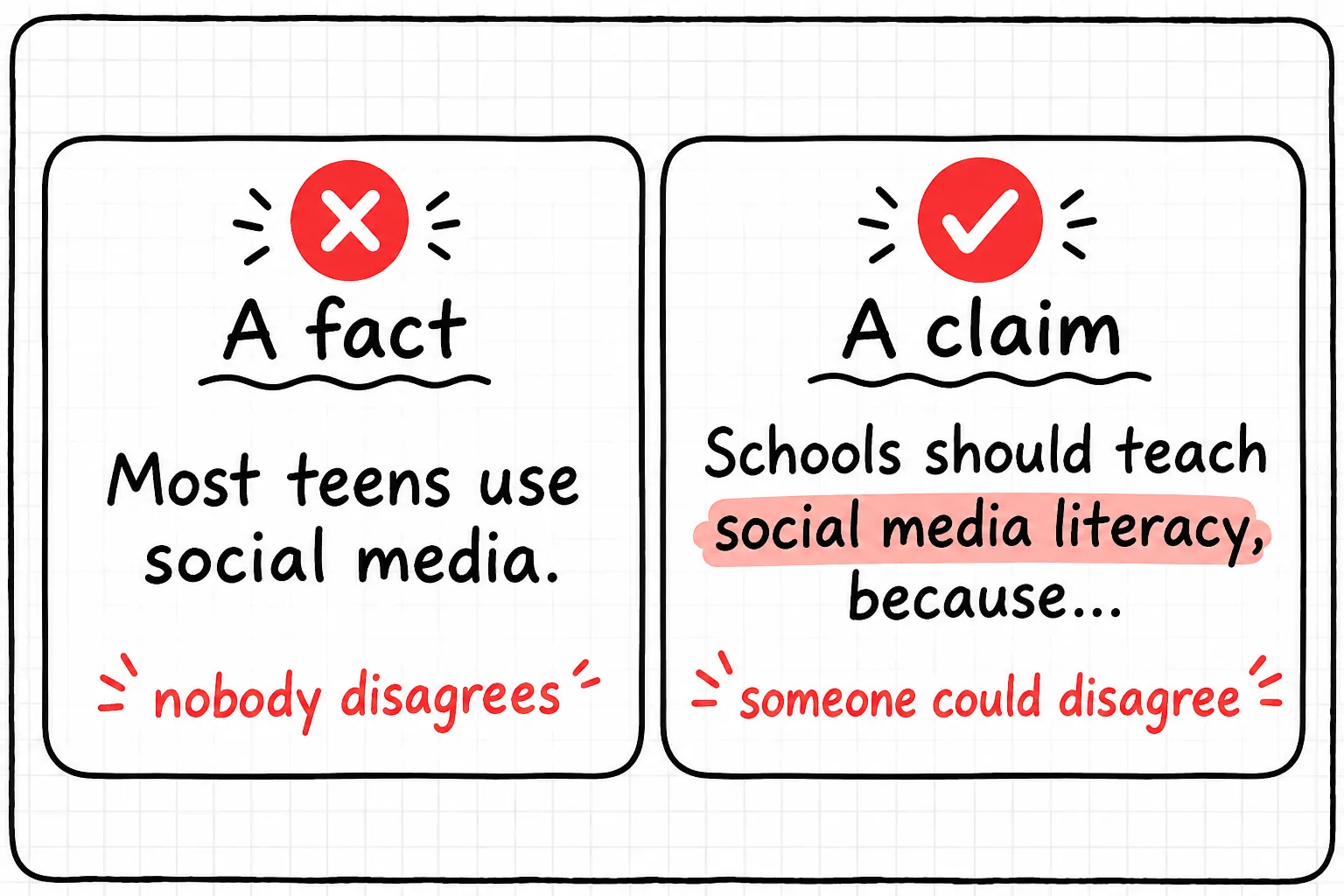
If nobody could reasonably disagree, it's a fact, not a thesis.
- Weak: Social media is used by most teenagers.
- Strong: Schools should teach social media literacy as a required course, because teenagers already learn most of their news there and few can tell sponsored content from reporting.
Test it: can you imagine a smart person arguing the opposite? If not, add your position.
Check 2: Is it specific?
Vague words like "important", "many", "interesting" or "has an impact" hide the actual claim.
- Weak: Climate change has a big impact on agriculture.
- Strong: Rising summer temperatures are cutting corn yields in the US Midwest, and drought-resistant seed programs are the fastest way to protect farm income.
Test it: underline every vague word and replace it with the specific thing you mean.
Check 3: Is it focused enough for the length?
A five-page paper can't prove a claim about "the history of education". The narrower the claim, the deeper you can go.
- Weak: The Industrial Revolution changed society.
- Strong: The spread of factory work in 1830s Manchester pushed children out of family workshops and into the first public debates about child labor laws.
Test it: could you prove your thesis well in the word count you have? If it would take a book, narrow it.
Check 4: Does your essay actually prove it?
Theses drift. You write the introduction first, your ideas change as you research, and the final essay argues something slightly different.
Test it: read only your thesis, then only the first sentence of each body paragraph. Does every paragraph support the thesis? If a paragraph argues something else, either change the paragraph or update the thesis to match what you actually proved.
Check 5: Is it in the right place?
In most US college essays, readers expect the thesis at the end of the introduction (Purdue OWL). Hiding it in the middle of the first paragraph, or saving it for the conclusion, makes the reader work to find your point. Unless your instructor asks for something else, put it there.
A quick self-check
Before you move on, your thesis should pass all five:
Get an outside opinion
You can't read your own thesis as a stranger would, because you already know what you meant. That's why it's worth showing it to someone else: a classmate, a tutor or your school's writing center.
PickyProf reads your whole essay the way a picky professor would, so it doesn't judge your thesis in isolation. It checks whether your argument holds together from the introduction to the conclusion and whether your claims are backed up, and flags the places where your essay drifts from its point.
Want to know if your argument holds up? Upload your essay to PickyProf and see where it's strong and where it drifts.